
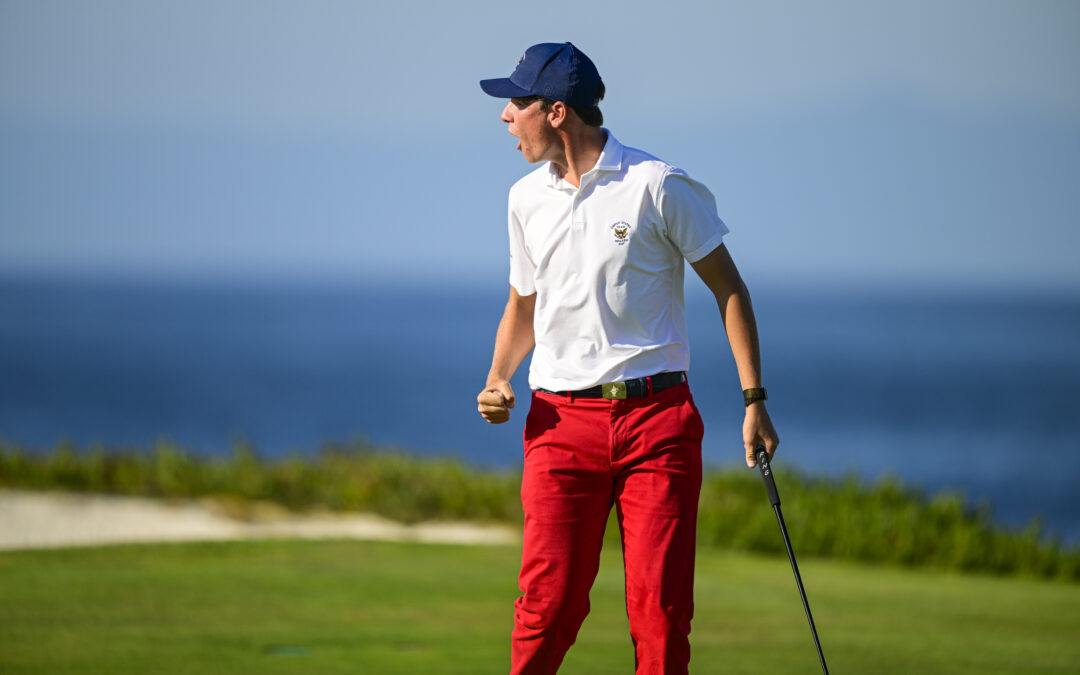
The Hub recently had the pleasure of talking shop with Mason Howell, an outstanding young player from Thomasville, GA. You can find a summary and key excerpts from the conversation below. Quick Nine Participants: Reese Moseley (RM), Rick Dowling (RD), and Mason Howell (MH)
I. Roots in Southwest Georgia; The Influence of Glen Arven & Bill Connally
RM: Mason, you grew up in Southwest Georgia in the relatively small, close-knit community of Thomasville. The club you play out of, Glen Arven, has produced some great players recently—PGA Tour winner Harris English and U.S. Women’s Amateur champion Megan Schofill. Talk to us about growing up around those players and how they helped you develop.
MH: Absolutely. Growing up in South Georgia and having someone like Harris to look up to proved it can be done from down here. He was here until high school before going to boarding school in Tennessee, but he always came home for coaching. Seeing how he progressed through college and into his early pro days—where he had immediate success—was huge. Seeing how he handles the hard times on Tour to now playing some of the best golf of his life is awesome.
Then there’s Megan, who is closer to my age. I’ve been able to play with her consistently whenever she’s home from college or now as a professional. Having those two to look up to while trying to add to the legacy of the club is pretty special.
RM: You’ve previously mentioned Bill Connally as an instrumental figure in junior golf at Glen Arven. What value did you find in working with him over the years?
MH: Bill is awesome. One thing Glen Arven does best—thanks to Bill—is getting juniors involved. Whether it’s blocking off tee times or hosting junior camps, he made the game accessible. Over the summers, he’d find a two-week stretch where we were all home and take a group of ten of us on a road trip to play golf. Out of those ten kids, six ended up playing Division I golf. He developed a group that bonded together, which naturally made our games better. He encouraged us to compete—playing for who’s buying dinner and things like that. I owe a lot to him for providing that environment.
II. A Historic 2025 Summer
RM: You had an incredible 2025. You won the state high school tournament, qualified for the U.S. Open at Oakmont as the youngest player in the field, were the medalist at the U.S. Junior, and then became the third-youngest winner of the U.S. Amateur at The Olympic Club after advancing through a playoff as the 63rd seed. Then, you were named to the Walker Cup team. What memories stick out most?
MH: I have to start with the state championship—winning another ring with my guys back home is always the best. I even had a memorable shot in that final round off of a bridge, though I wouldn’t recommend that to anyone!
Going into the summer, playing in a Major at 17 and stacking my game against the top pros gave me a lot of confidence. I took things I learned at Oakmont and applied them to The Olympic Club. For example, watching Jordan Spieth chip at Oakmont really helped me learn how to handle the thick rough at The Olympic Club. The U.S. Amateur was one of the greatest weeks of my life, which rolled right into the Walker Cup at Cypress Point. Playing that course every day for a week was a dream.
III. The Walker Cup & The “2-2 Club”
RM: Let’s talk about the Walker Cup. You shot a 59 at Glen Arven the day before you flew to San Francisco. At Cypress Point, you made an albatross on the par-5 2nd hole, an eagle on the 17th, and joined the exclusive “2-2 Club” by going 2-2 on the famous par-3 15th and 16th holes. What was that experience like?
MH: That week was crazy. I didn’t even think I had a chance to make the team before the U.S. Amateur, so everything changed in two weeks. I didn’t know the other guys well, so the first part of the week was about building trust. It’s team golf; you have to trust your partner.
Meeting people like President George W. Bush, Condoleezza Rice, and Jim Nance was incredible. We even got a “pump-up” speech from Bryson DeChambeau. One highlight was a video we saw from Tiger Woods on Friday night. He told us: “No sixes, no three-putts.” Every time I was in a tough spot on a par-5, I just thought, “Don’t upset Tiger.” It worked!
IV. Evolution of the Mental Game
RD: Has your approach to golf changed over the last five years? What did it look like when you were 12 or 13 compared to now? Has it intensified, and do you use a mental coach or a strict gym routine?
MH: A lot has changed. When I was 12 or 13, I was probably too hard on myself. I was still trying to figure out which sport I wanted to pursue. As I got older, I realized that playing with buddies and making practice fun keeps you interested. Golf is a game that can “throw you away” quickly if you aren’t careful.
Now, my schedule is much more structured. I have consistent workout routines and a training schedule. I used to go to the range, get frustrated, play four holes, get frustrated again, and go home. Now, it’s about keeping it laid back but disciplined. You’re always going to be frustrated at some point, but it’s how you deal with it. You can be mad for 30 seconds, but if you’re still thinking about a bad drive while standing over a putt, it’s not going to end well.
RD: Do you still get frustrated often?
MH: Oh, definitely. If I make a bogey at my home course, it feels terrible because I know every nook and cranny of that place! But I’ve learned that a bad attitude leads to bad golf. I used to give that advice and not follow it; now that I’ve matured, I actually listen to myself.
RD: You seem wise beyond your years regarding frustration and the “long game.” Was there a pivotal moment where this mindset clicked for you?
MH: It definitely took time. When I was younger, my dad probably wanted to yank me off the course a few times for having a bad attitude! Everyone goes through it. Recently, I’ve learned to simply walk away from a bad shot and focus on the next challenge. I try to view a recovery shot as a fun opportunity rather than a disaster.
At the Walker Cup, I had some big moments where my celebrations were just pure reactions. But overall, I realized about five years ago that a bad attitude leads to bad golf. I wasn’t even listening to my own advice back then! Now that I’ve matured, I’ve learned that playing “mad” just doesn’t help. More reps taught me how to play through the frustration.
V. Navigating the Junior Circuit
RD: Reese touched on the peak events you played in recently, but looking back at the last five or six years, how did you navigate the junior golf space? What can you share with the young up-and-comers who want to follow in your footsteps?
MH: When I was younger, it was essential to play local tours to get a feel for real competition. You don’t want to take too much time off; you need to compete regularly. Between ages 12 and 13, I played the Southeastern Junior Golf Tour. Even if there were only a few of us in the field, there were usually two people battling it out, which gave me that competitive edge.
From there, I moved into the AJGA and the “normal” system, but my philosophy was to play as much as possible. You can learn so much from tournament reps that you just can’t get on the range. I started regionally, moved nationally, and have now transitioned to a full amateur schedule. My final junior tournament will be at Sage Valley this March. Throughout the process, I focused on exposure for college, but I tried not to let it distract me from the golf itself.
VI. The Georgia Recruitment
RD: You’re from a “big Georgia family.” Can you describe your recruiting process? Was it always the University of Georgia, or did you explore other options?
MH: I went into the process with an open mind. I was fortunate enough to be in a position where I didn’t have to send out a ton of emails to get noticed. My family ties to UGA are deep—my dad went to law school there, my mom did her undergrad there, and my sister is there now.
I took visits elsewhere, but I realized UGA was where I’d be happiest. I already have a lot of buddies there, and we have a great recruiting class coming in. My biggest piece of advice for recruits is: don’t let the process overwhelm you or affect your play. If you feel like you aren’t happy at a certain school, don’t go there just for the name. Also, if a coach is pressuring you on a timeline, that’s usually a sign they aren’t the right fit. It should be a time you remember for the right reasons.
VII. Advice for the Next Generation
RM: What is your best advice for an aspiring male or female player who dreams of playing Division I golf?
MH: It’s all about consistency. When you’re sitting on the first tee of a tournament, don’t search for the “perfect” round. Usually, three good rounds will put you exactly where you need to be. Don’t put too much pressure on yourself, and keep smiling. If a coach comes to watch you, try to view them as just another parent in the gallery. I’ve seen people fold under that pressure, which is unfortunate. Take it as it comes and stay laid back.
VIII. The Major Championships & The Move to Athens
RM: Your U.S. Amateur win opened doors to the Masters in April, the U.S. Open at Shinnecock Hills in June, and The Open at Royal Birkdale. What are you looking forward to most?
MH: There’s so much to look forward to. At Augusta, I’ll be paired with Rory McIlroy for the first two rounds. If I can hang with him, I think I’ll be doing alright! I’m focused on being as prepared as possible for everything that course can throw at you.
Shinnecock will have a different vibe than Oakmont, but I know it’s one of the hardest tests in golf. As for The Open, I’ve never played links golf, so I’m going over early to get some reps in and experience that environment.
Looking ahead to this fall, I see college golf at Georgia as a huge stepping stone. With the PGA TOUR University system, you can reach the professional level faster than ever. I can’t wait to play alongside my best buddies and compete for a national championship.
RD: Mason, it’s been a pleasure. We’ve loved watching your accomplishments this year, and we wish you the best at the next level.
MH: I really appreciate you guys. Reese, it was good to see you again—hope you’re surviving the cold up north! I’ll stay in touch, and I look forward to getting some golf lined up with you all soon.
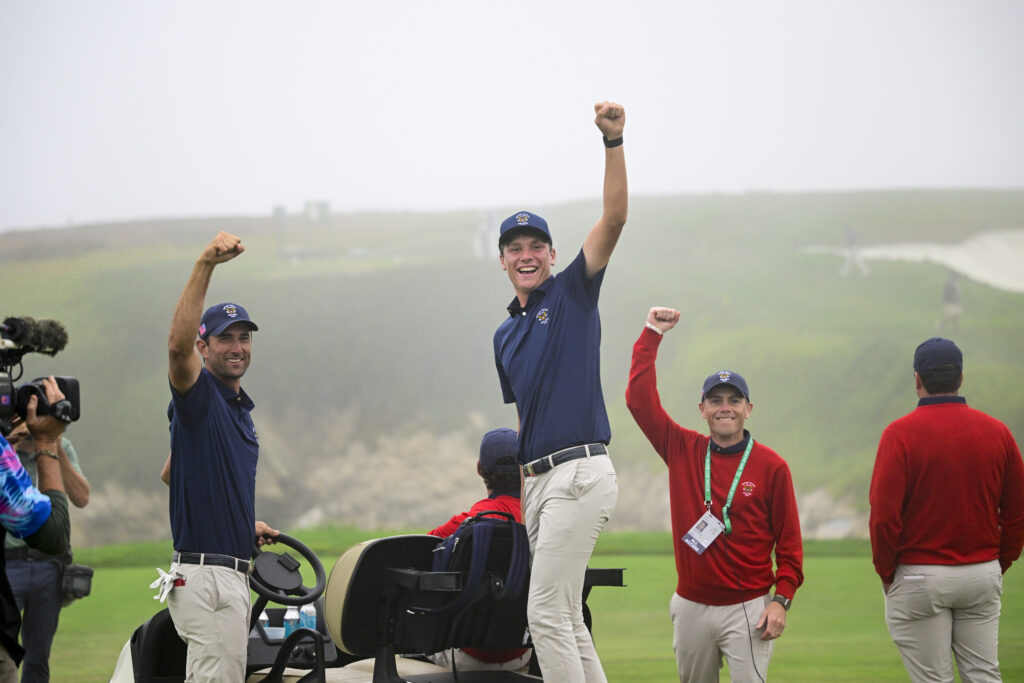
Stewart Hagestad, Mason Howell, and Reese Moseley (USA) celebrate their win during singles matches of the 2025 Walker Cup at Cypress Point Club in Pebble Beach, Calif. on Sunday, Sept. 7, 2025. (Logan Whitton/USGA)
IX. Goals for 2026 and Beyond
RM: What were your goals at the start of 2025, and how have they expanded for 2026?
MH: My 2025 goals were actually pretty far-fetched at the time! I wanted to qualify for at least three USGA championships—the Four-Ball, the U.S. Open, the U.S. Amateur, or the U.S. Junior. I also wanted to win a mid-major junior event. While the win didn’t happen exactly how I planned, I focused on climbing the WAGR (World Amateur Golf Ranking) and maintaining an upward trajectory.
For 2026, I want to get a couple of Amateur wins under my belt and aim for “Low Amateur” honors in the Majors. Mostly, I’m just focused on playing consistent golf.
Photo Credit: USGA