
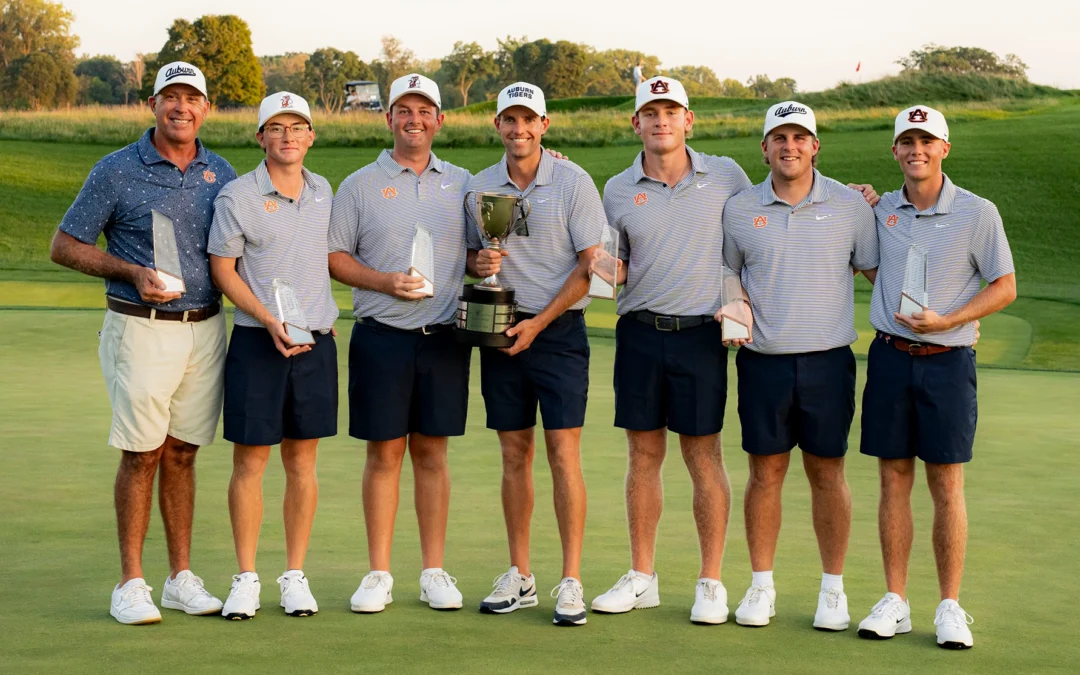
A three-day tournament decided by one stroke is the clearest lesson in junior golf there is: no hole is a throwaway.
Eight hundred sixty-three to 864. That was the final margin at the Inverness Intercollegiate — three days, 54 holes, five players a side, and the whole thing came down to a single shot. Auburn won it, and for a junior golfer or a parent trying to understand where tournaments are actually decided, that number is the entire lesson: the round you’re tempted to mail in is the one that beats you.
Per AmateurGolf.com, the reigning national champion Tigers posted 11-over 863 at Inverness Club in Toledo, Ohio, to edge host Toledo and East Tennessee State, who tied for second one back at 12-over 864. Auburn’s Bence Bertenyi was the individual medalist at 210 (70-71-69). And the round that made the math work was Logan Reilly’s closing 66 on Tuesday, which Auburn Athletics put in its headline. It was Auburn’s second Inverness title, a decade after its first in 2016, and the defending champion’s first win of the new season.
Here’s the Hub’s read on it, and this is our opinion, not a line from the box score. Junior golfers are taught to chase the hero shot — the eagle, the holed bunker shot, the birdie on the last. Those make the highlight. They don’t win the tournament. A one-shot margin means a stray double bogey on the fifth hole of round one cost Auburn exactly as much as it would have cost them on the 54th. Every shot across three days was worth the same. The tournament wasn’t won on Tuesday afternoon; it was won by not giving away the shots on Saturday morning that everyone forgets by Sunday.
For a junior reading this, or a parent watching a scorecard come home, the useful reframe is this: there are no throwaway holes, and there is no throwaway round. The 74 you grind out when nothing is working is worth as much to your week as the 66 you post when everything is. Reilly’s 66 is the part that makes the headline, but it only counts because four teammates kept the number close enough for it to matter. Bogey avoidance isn’t glamorous, and it’s what separates the team holding the trophy from the two tied one shot back.
If you want to see how the deepest programs in the country are actually built — not one star, but a full lineup that protects a one-shot lead — look them up in the Hub college database.