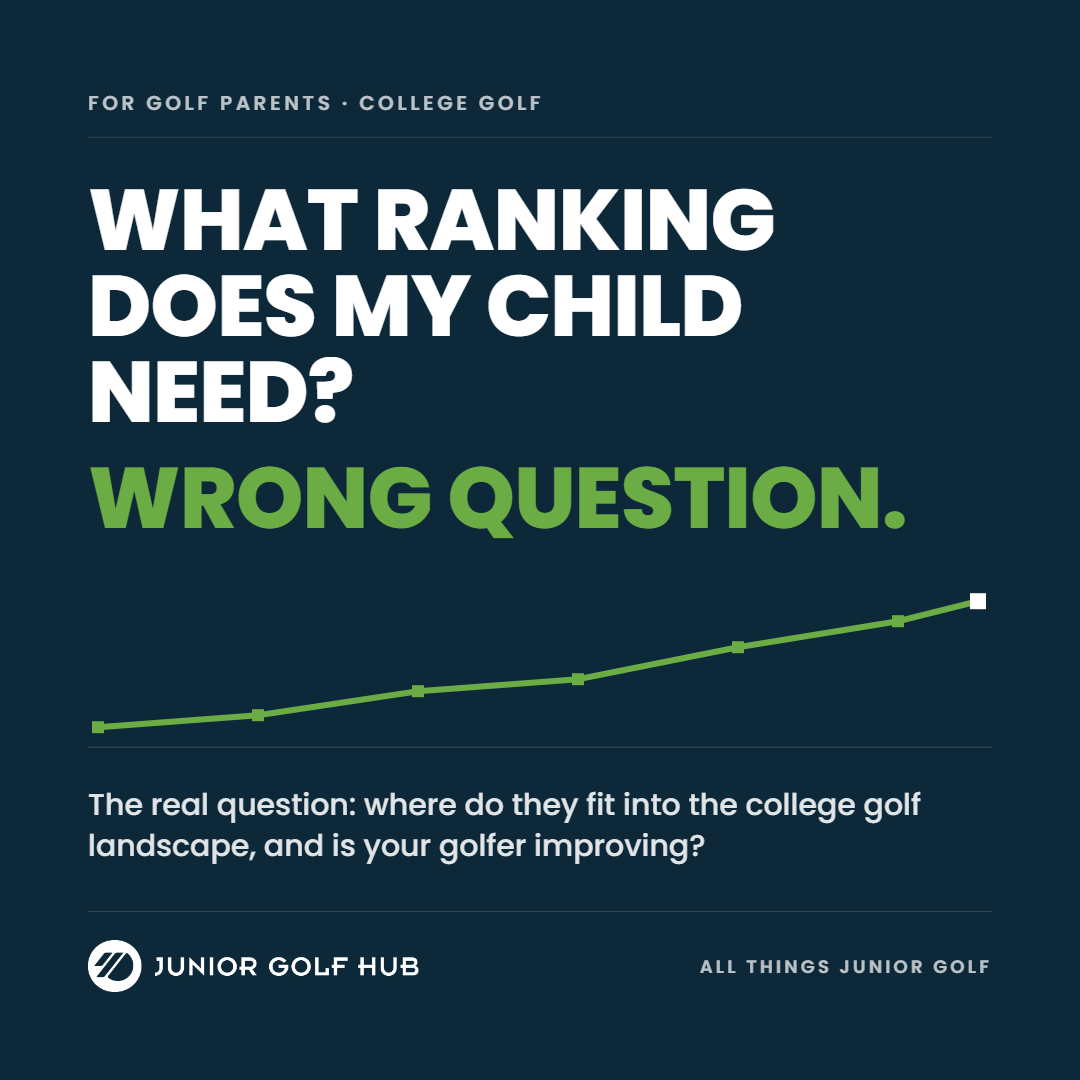
A PARENT ASKED ME LAST WEEK WHAT RANKING HER SON NEEDS. HERE IS THE ACTUAL PROCESS, YEAR BY YEAR — AND WHY THAT QUESTION NEVER APPEARS IN IT.
By Rick Dowling ·
It’s a completely reasonable question. I want to answer it properly, by showing you what the process actually consists of.
So here’s the real thing, by grade. Not my opinion. This is the checklist we publish.
Freshman year. Confirm you’re on track for NCAA core courses. Start a target list of 30-plus colleges using the Hub college database. Learn the scoring averages of the programs on it. Play 8–12 events, and understand the difference between local, state, and national ones. And this one is first on the list for a reason: build a long-term development plan with a coach that covers golf, physical, and mental skills.
Sophomore year. Take the PSAT or PreACT. Refine your list, still 30-plus schools. Set scoring goals. Play 10–12 events, including 36-hole and ranked events. Start reaching out to coaches by email, phone, and handwritten note, and keep a correspondence log. Most Division I coaches can’t reply until June 15 after sophomore year, so don’t read silence as a no. Take unofficial visits. And learn how junior golf rankings work.
Junior year. Take the SAT or ACT. The NCAA no longer requires scores for Division I or II eligibility, but many admissions offices still use them. Register with the Eligibility Center. Play 10–15 events. Take official and unofficial visits. And follow the instruction that tells you more about this process than anything else I could write: contact coaches at programs where your scoring average is near their #3 to #5 players.
Senior year. Narrow to 5–10 schools. Submit applications. File the FAFSA as soon as it opens, and check each school’s priority deadlines. Sign your written athletics aid agreement during the signing window. Keep playing, 10–18 events.
Now go back and read that again, because of what is not in it.
There is no ranking target. Not in any year. Rankings appear exactly once, in sophomore year, as something to learn about, the way you’d learn how the Eligibility Center works. They’re part of the landscape you need to understand. They are never listed as a thing to achieve.
And look at what sits in the very first year, before anything else: a development plan covering golf, physical, and mental skills.
That ordering is the whole answer to the question I was asked.
Here’s why the process is built that way.
Look at the junior-year instruction again: find programs where your scoring average sits near their #3 to #5 players. That isn’t a ranking instruction. It’s a fit instruction, and it’s keyed to a number that updates every time your child plays.
Our own 2026 College Golf Report sorted all 304 men’s and 274 women’s Division I programs into eight competitive tiers, from National Powerhouses down to Program Starters, across an audit of more than 2,000 programs. Eight tiers. The job is finding which one fits, and where on that roster your child would actually sit.
A national ranking can’t do that job. It gives you one number against every junior in the country. It can’t tell you where your child lands inside one specific nine-player roster, which is the only question a coach is asking.
And the roster math is tighter than most families realize.
Since 2025, Division I programs in the House settlement have been capped at nine players, men and women. Walk-on pathways are largely gone at the Power Four. By our reporting, programs now fill an estimated 30 to 40 percent of Division I men’s spots from the transfer portal each year. That leaves high school seniors competing for roughly 1,500 to 1,800 Division I spots nationally.
So when a coach has one spot, they aren’t comparing your child to the national field. They’re comparing your child to a 21-year-old who has already proven they can shoot those numbers in college.
Think about what actually wins that comparison. It isn’t where your child ranked last spring. It’s a credible case that in two years, they’ll be better than the transfer is now.
That’s a trajectory argument, and it’s the reason we keep calling a ranking a lag factor.
We mean something precise. A ranking is a processed, delayed report on golf your child has already played. It arrives weeks after the event, compresses a season into one figure, and tells you where your child stood. It’s a receipt. Receipts are worth keeping.
But a receipt can’t tell anyone which way your child is going, and direction is the entire question in a nine-spot room.
The coaches say this themselves. We surveyed more than 500 of them. They told us rankings have a moderate impact, and that they pair rankings with in-depth stats and trends. They also told us they put tournament results ahead of rankings, with a strong preference for performance-based data.
Moderate. Paired with trends. A preference for performance-based data.
So what do you actually do? Five things, and they’re all on the checklist.
One. Work the list, not the ranking. Start with thirty-plus schools in freshman year and narrow to 5–10 by senior year, chosen by where your child’s scoring average sits against a real roster. Treat Division II, Division III, NAIA, and NJCAA as primary targets, not fallbacks. Those programs aren’t bound by the Division I roster cap. That’s our recommendation, not a consolation prize.
Two. Start the development plan early and keep it. Golf, physical, mental. It’s item one in freshman year because everything else is downstream of it.
Three. Measure what a scorecard can’t see. Physical, skills, mental: measure them twice, far enough apart to show a direction. A direction is the thing you’re actually trying to prove.
Four. Do the academic work on schedule. Core courses, tests, the Eligibility Center, and the FAFSA. Our College Golf Report found a GPA north of 3.8 is real leverage for one of those nine spots at the most selective programs. Academics aren’t the tiebreaker. They’re the filter.
Five. Keep the correspondence log, starting sophomore year. The process rewards families who are organized far more than it rewards families who are anxious.
And if your senior signs on Wednesday, none of this touches that day. Go enjoy it completely. November 11 is a starting line, not a deadline.
The question is never what ranking your child needs. It’s which nine-player roster they fit, and whether a coach believes they’re still going up. The first is research. The second is development. Neither one is a number you refresh.
Junior Golf Hub — All Things Junior Golf.
🔗 Read more: The Transfer Portal Squeeze: How the College Golf Roster Reset Changes Everything for Junior Recruits
#JuniorGolf #CollegeGolf #GolfParents #PlayerDevelopment #JuniorGolfHub #StudentAthlete #CollegeGolfJourney