
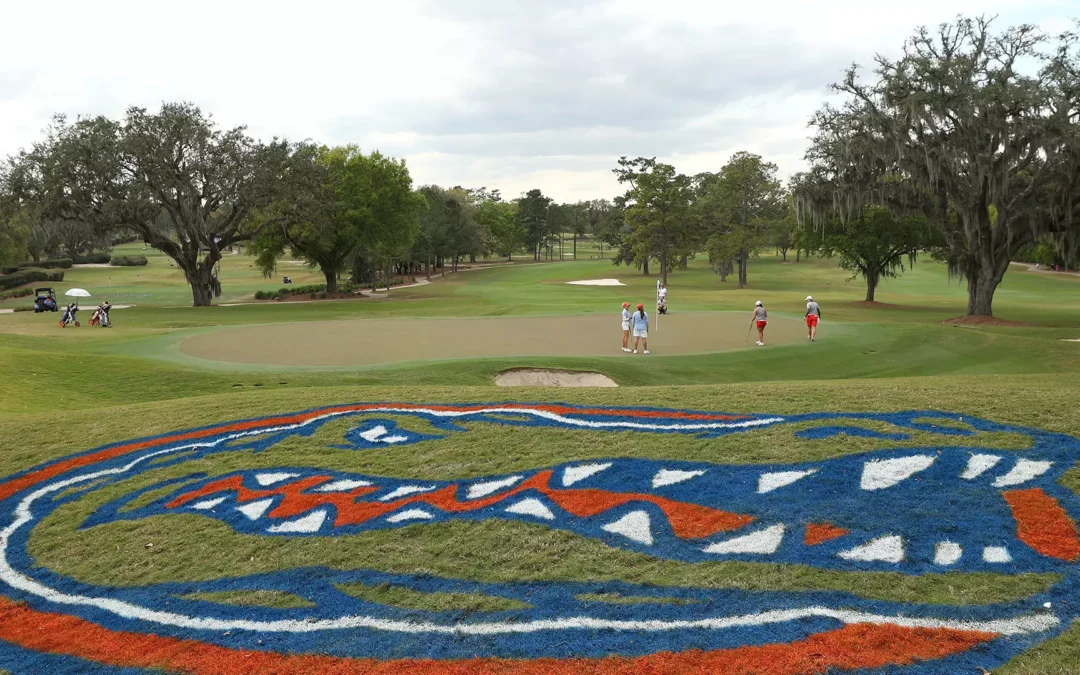
A 500-acre facility gift doesn’t change what Florida’s roster looks like this year. It changes what every recruit sizing up the Gators over the next five years will see.
University of Florida’s men’s and women’s golf teams are getting a new home. On Thursday, the athletic department announced plans for the Evans University of Florida Golf Club — an 18-hole championship course on a 500-acre tract in west Gainesville, designed by architects Beau Welling and Steve Smyers, paired with a new performance center called the Power Design Team House. For a junior golfer building a recruiting list, or a parent trying to read what a program’s “trajectory” actually looks like, this is the kind of story worth more than a scroll-past.
Per Golfweek, the project is funded by a “transformational gift” from Consumer Cellular CEO Ed Evans, with the performance center made possible by a donation from Power Design, a St. Petersburg-based contractor. Florida’s men’s program enters the season rated No. 1 in the country in Golfweek’s preseason rankings, led by elite amateurs Luke Poulter and Jack Turner, and has five national titles in its history, most recently in 2023. The women’s team sits at No. 7, powered by senior Paula Francisco, a projected national player of the year contender. The school hasn’t given a timeline for completion, and says the Gators’ current home, the Donald Ross-designed Mark Bostick Golf Course, isn’t going anywhere in the meantime.
Here’s the Hub’s read on it, and this is our opinion, not a line from the release. Juniors and families tend to evaluate a program by what’s true right now — this year’s roster, this year’s ranking, this year’s results. A facility announcement like this is a different kind of signal, and it’s one worth learning to read: it’s a program, and a donor base, betting on where the team will be in five or ten years, not where it is today. A school that can attract a 500-acre gift and a dedicated performance center isn’t just fielding a good team — it’s building an infrastructure that keeps producing good teams, and that outlasts any single class of seniors.
For a junior thinking about fit, the takeaway isn’t “go where the newest building is.” It’s learning to separate the two different things a program is telling you. Rankings and results tell you about the players currently there. Facility investment, donor commitment, and coaching continuity tell you about the environment a recruit would actually be training in for four years — and whether the program’s ceiling is rising or holding steady. Both matter, and they don’t always move together.
Want to see how a program’s roster, results, and trajectory actually connect? Look up Florida — and every program on your list — in the Hub college database.
Photo: UF Athletics