
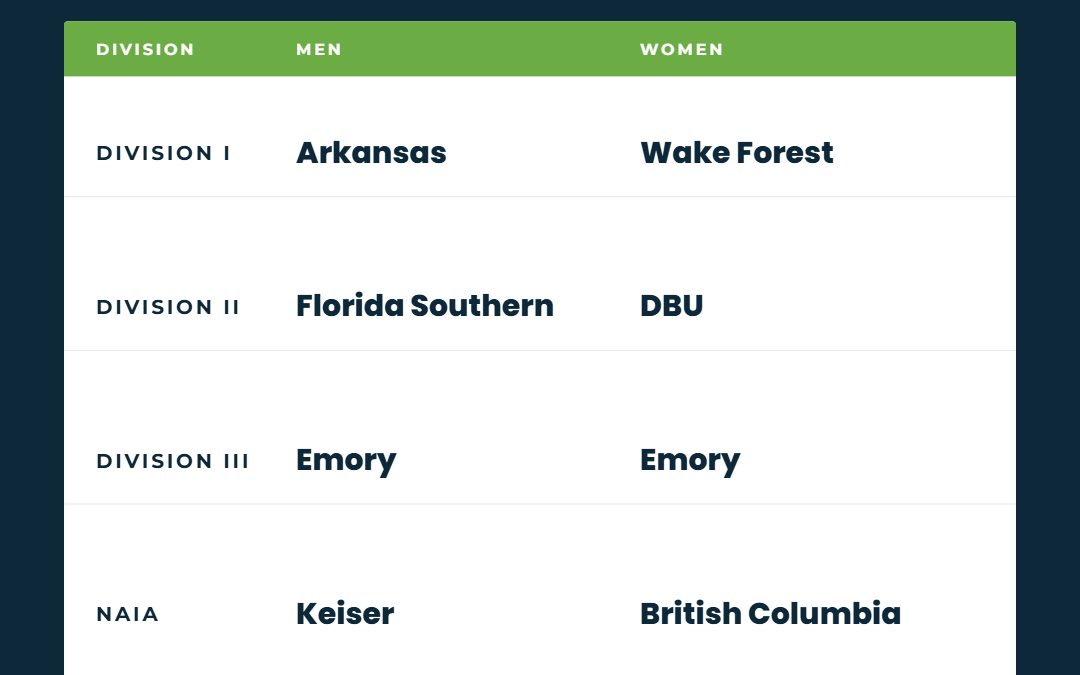
The first college golf rankings of 2026-27 are out, and the early leaders show exactly how a player’s number gets built.
The No. 1 women’s player in Division I right now hasn’t won a college tournament this season, and she plays in the Ivy League. That alone tells you the first Clippd Scoreboard rankings of 2026-27, released Oct. 14, are worth a closer look.
A quick note on how these numbers work, because it explains almost every story below. Clippd’s national ranking, built with strokes-gained creator Mark Broadie, awards points at every event based on how many strokes a player or team gained on the field. It adjusts for course difficulty and field strength, and margin matters: winning by five beats winning by one. Points are then averaged by rounds played. Per Clippd’s methodology page, there’s no built-in advantage or penalty for playing in strong or weak events. Your score against the field does the talking.
The second note: it’s mid-October. Most teams have played two to four events, and most players five to 12 rounds. These are first impressions, not verdicts. They’re still fun, and some of them are already telling us something.
Division I teams: a photo finish and a runaway
| Rank | Men | Avg. pts | Wins | Women | Avg. pts | Wins |
|---|---|---|---|---|---|---|
| 1 | Arkansas | 82.62 | 2 | Wake Forest | 108.02 | 2 |
| 2 | Auburn | 82.58 | 1 | Southern California | 83.74 | 1 |
| 3 | New Mexico | 73.94 | 2 | Auburn | 80.39 | 1 |
| 4 | Alabama | 73.58 | 1 | Virginia | 75.64 | 1 |
| 5 | Texas Tech | 73.26 | 0 | South Carolina | 68.58 | 0 |
Source: Clippd Scoreboard, updated Oct. 14, 2026.
On the men’s side, the top spot is as close as it gets. Arkansas leads Auburn by four-hundredths of a point. The Razorbacks have the busier résumé: wins at the Vuori Invitational and the Blessings Collegiate Invitational, plus a runner-up at the Bryan Bros Collegiate at 18-under. Auburn has played just two events, winning the Inverness Intercollegiate and finishing second at the Ben Hogan Collegiate, but Clippd rates its schedule the toughest in Division I. That’s the trade-off in miniature: Arkansas has more results, Auburn has stronger ones.
The names worth circling sit just below. New Mexico, from the Mountain West, is No. 3 after winning the Canadian Collegiate Invitational and finishing second twice. East Tennessee State, from the Southern Conference, is No. 8 with back-to-back wins at the Highlands Invitational (21-under) and the Trinity Forest Invitational (32-under), and a 41-1-1 head-to-head record against other teams. Neither program needed a power-conference logo to get there.
The women’s race isn’t close yet. Wake Forest averages 108.02 points, more than 24 clear of No. 2 Southern California. The Demon Deacons won the ANNIKA Intercollegiate at 24-under (840) and the stroke-play portion of the Jackson T. Stephens Cup, against what Clippd rates as the strongest schedule in the division. That combination is how you build a gap that size in two events.
Division I players: how the No. 1s got there
Thanana Kotchasanmanee, Princeton (No. 1, women). The second-year has played only two events and five rounds, and she hasn’t won either one. She finished third at the Princeton Invitational at 1-under, then second at the Blessings Collegiate Invitational at 9-under (207). That Blessings week earned her 110.4 points, and it’s why she’s on top. Across five rounds she has beaten 119 of the 122 players she’s faced, with a field-adjusted scoring average of 66.31, the lowest among Division I’s top-ranked women. Clippd’s model doesn’t care what conference you play in, only how many strokes you gain on the field. She gained a lot.
Ryder Cowan, Oklahoma (No. 1, men). The fourth-year’s season shows what one big week does. He won the 2nd Swing Gopher Invitational at 13-under (200), worth 167.6 points, the biggest single result among the men’s top five. His other two events, a fourth at Inverness and a ninth at the Ben Hogan, were solid rather than spectacular, and he still leads at 109.85.
JD Culbreth, Georgia (No. 2, men) is right behind him on two starts: third at the Gopher and second at the Ben Hogan at 6-under, a finish worth 141.9 points against one of the fall’s strongest fields.
Johnnie Clark, New Mexico (No. 3, men) has the cleanest record in the country: three stroke-play events, three wins, including 13-under at the William H. Tucker Invitational. He’s 174-1-1 head-to-head. His only blemish is a match-play loss at the NB3 College Matchplay.
Max Emberson, Georgia Tech (No. 12, men) is the top first-year on the men’s board. He won his first two college events, the Folds of Honor Collegiate (11-under) and the OFCC/Fighting Illini Invitational (13-under). Our read: that’s as fast a start as you’ll see.
On the women’s side, Texas’s Farah O’Keefe (No. 4) is unbeaten at 51-0-2. She won the Jackson T. Stephens Cup stroke play, won her match there, and shared the individual title at the St Andrews Links Collegiate this week. Auburn’s Anna Davis (No. 3) has won two of three, most recently the Haskins Intercollegiate at 13-under. Wake Forest’s Chloe Kovelesky (No. 2) hasn’t won yet but has finished second and third against the toughest schedule in the division. And Virginia first-year Zoe Cusack is already No. 10, led by a third-place finish at the Canadian Collegiate Invitational.
Division II, Division III and NAIA: where the perfect records live
Some of the season’s most dominant golf is happening outside Division I.
NAIA men: Keiser is 3-for-3. The Seahawks won the PDI Shootout, The Invite at Innisbrook and the Jupiter Collegiate Invitational, the last one at 46-under, and they’re 28-0 against other teams. Their 151.5 average points are the highest of any team in any division. Keiser also has four of the top 10 NAIA men, led by No. 1 Stanley Campbell, who finished second at Innisbrook and has lost to only five players all fall.
Division III: Emory leads both boards. The men are No. 1 after a win and another top-three finish in three events. The women are No. 1 after winning The Tartan Invitational at 18-under and a match-play win at the UAA Championship. Second-year Amanda Zheng won the Tartan at 11-under (205) and is the D-III women’s No. 1, with 107.3 points.
The best stat in college golf right now might belong to Lauren Paige Slatton of Rose-Hulman, the D-III women’s No. 2. She’s three-for-three in stroke play and 285-0-2 head-to-head, which means nobody has finished ahead of her all fall. On the men’s side, Claremont-Mudd-Scripps second-year Sebi Aliaga is perfect too: two starts, two wins, 125-0-0, including a 20-under (196) at the CA State Intercollegiate.
For our Connecticut readers: Trinity first-year Zorah Williams is No. 5 among D-III women. Her season is a lesson in bouncing back. She finished 30th at the George Phinney Jr. Classic, then came back with a third at the Williams Fall Invitational and a win at the Wesleyan Women’s Invitational a week later.
Division II: Florida Southern leads the men with three of the top four players, including No. 1 Jack VanderSchuur, who won The National Preview at 13-under. DBU leads the women. St. Mary’s (Texas) fourth-year Taylor Wilczek is the clear No. 1, with 69.8 points to the next player’s 54.0, after winning the DBU Classic.
NAIA women: British Columbia leads the teams and is 16-0. Texas Wesleyan’s Makena Junkin has won two of three, including 14-under at the Northwest Iowa National Invitational, and leads the next player by nearly 20 points. Rocky Mountain first-year Natasza Klimko already has three wins in five starts.
What we’ll be watching
The Hub’s predictions, and these are our opinions, not Clippd’s:
- The Princeton number will move. Five rounds is a small sample, and one more strong week, or one rough one, swings an average fast. What won’t change is that Kotchasanmanee earned No. 1 by beating nearly everyone she played.
- Arkansas vs. Auburn stays a coin flip until Auburn adds events. A team with the hardest schedule in the country and two good results is a team to bet on.
- Wake Forest’s lead shrinks but holds. A 24-point gap tends to compress as everyone plays more, but it’s a big cushion to start from.
- Keep an eye on East Tennessee State and New Mexico. Mid-major programs ranked this high in October have usually earned it.
What this means for you
If you’re a junior thinking about college golf, these rankings are a free lesson in how you’ll be measured. Clippd’s system rewards beating the field, by as much as you can, wherever you’re playing. Kotchasanmanee didn’t need a win to reach No. 1. Zorah Williams didn’t let a 30th-place week define her season.
Two practical steps. First, start tracking your own scoring relative to the field, not just your raw scores. A 72 at a tough event can be worth more than a 69 at an easy one. Second, look at every level. Some of the most dominant players in the country right now are at Rose-Hulman, Claremont-Mudd-Scripps, Keiser and Texas Wesleyan, and every one of those programs is part of somebody’s Roadmap.
Want to see where these programs fit yours? Explore all of them in the Hub college database.